
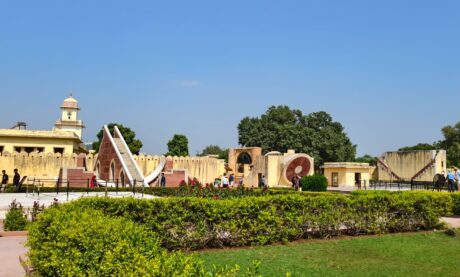
Jantar Mantar Jaipur: Exploring the Scientific Wonder Behind Rajasthan’s Royal Heritage
What Makes Rajasthan Unique.
Rajasthan always felt like a dry and somewhat boring state while growing up in the southern part of India—almost the opposite in every sense. Maybe it was because of the presence of the Thar Desert that we learned about in school, or the frequent mention of Pokhran in the news.
But as travelling slowly became a passion and not just a plan, that perception changed completely. Rajasthan turned out to be one of those states that simply cannot be compared with any other—be it in terms of vibrancy, culture, diversity of places, or hospitality.
Being in Delhi was a blessing in that sense, as it gave me multiple opportunities to visit Jaipur. And somewhere along those visits, without even realizing it, I literally fell in love with the city.
Jantar Mantar – A Fort of Science in City of Forts
Jaipur is famous for its forts, palaces, gardens and temples. After visiting many of them, one may easily get an impression that the kings and emperors who ruled this land centuries ago were mostly inclined towards luxury—hunting, building grand monuments, and leaving behind visual spectacles. But a visit to Jantar Mantar is all it takes to change that perception completely. It reveals a different side of those rulers—academic, curious, and deeply invested in science, especially astronomy.
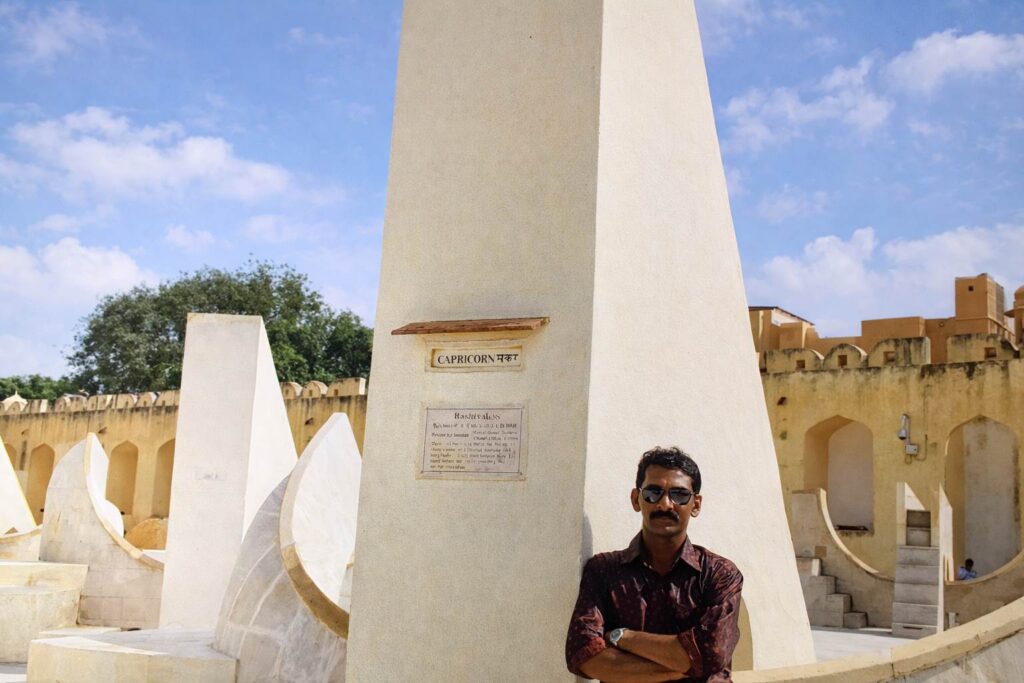
An astronomical observatory, in simple terms, is a place or instrument used to observe objects in the sky. Jantar Mantar is one such remarkable creation, constructed by Maharaja Sawai Jai Singh II in 1734. He built similar observatories in Delhi, Ujjain, Varanasi and Mathura, though the Jaipur one remains the best preserved.
Jantar Mantar – Where Yantra Meets Mantra
The name itself is interesting. “The word Jantar Mantar is a combination of two popular words which have direct connection with the purpose of the observatory. Jantar is an automatic version that British people were misplaced for Yantra (Machine) in their communication and Mantar means Mandir and both joined together with a meaning of Temple of Machines.
Jantar Mantar is spread over a vast area, perhaps several square kilometres, such that the huge, differently shaped structures are found to be negligible in terms of its size. The location is in the heart of the city, very close to Hawa Mahal and city palace. If the city buzzes with traffic, tourists, and chaos, then Jantar Mantar, right in the heart of Jaipur city provided a surreal atmosphere with its calmness.
Understanding the sky—the stars, the Sun, shadows, and their positions—can feel incredibly complex. The methods used to estimate their locations and distances are often intricate and demanding, making the whole subject seem beyond the grasp of an average human mind. In the same way, the sheer scale and brilliance of these massive observatory structures are equally awe-inspiring and difficult to fully comprehend.
Jantar Mantar – A UNESCO World Heritage Site and One of the Largest Observatories
Jantar Mantar consists of 19 huge observatories or instruments constructed with white marble and stones. It is a kind of ‘see it to believe it’ experience that requires the guidance of a proper expert to understand why and how these gigantic creations were made, although the working is displayed along with each instrument in both Hindi and English. Pre-recorded audio tapes are also available apart from the details inscribed in marble stones in major items.
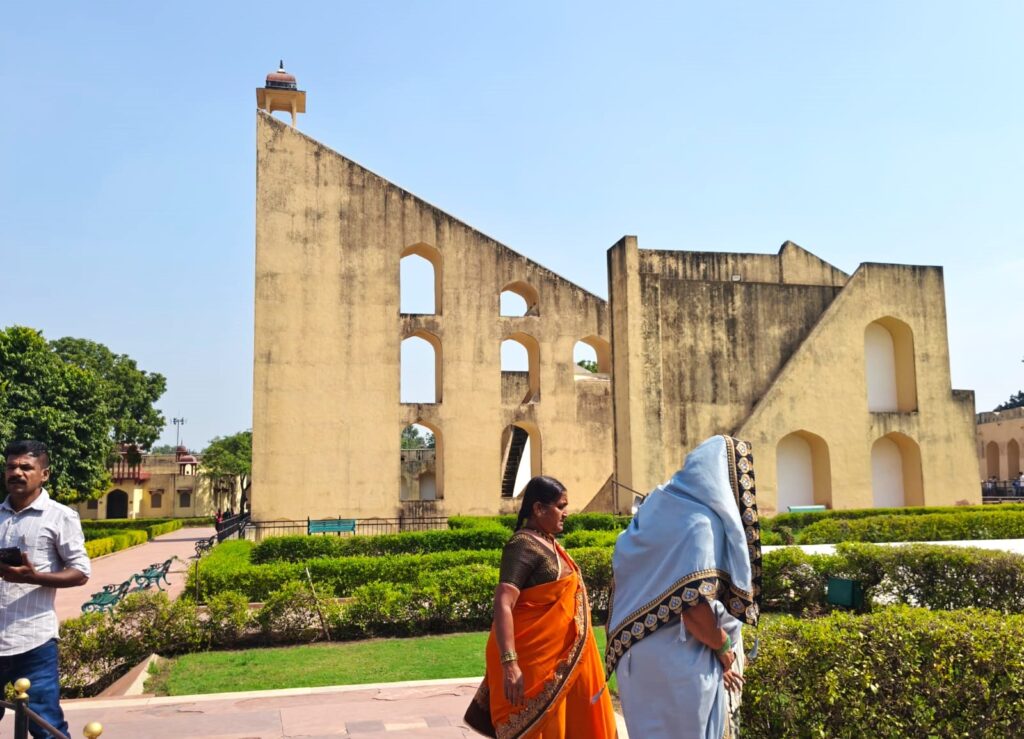
Its importance can be gauged by the fact that Jantar Mantar is a UNESCO-certified heritage site and has also the distinction of being one of the largest observatories ever built, which is still running with the same accuracy and precision.
It may not be practical to describe every structure built there, as each one is unique and possesses its own distinct features. This write-up aims instead to highlight the scientific achievements of the rulers of that time and their remarkable ability to translate concepts like time and longitude from the sky into precise readings on dials and indicators crafted in marble and stone, all based on the movements of the Sun and the Moon. It is truly fascinating to see how something as simple as shadows could be used to predict time, longitude, and more.
Jantar Mantar – Following the Shadow of the Sun
For many people, the technical language and scientific concepts of astronomy can feel difficult to grasp. In simple terms, much of it comes down to observing the Sun’s shadow. As the Sun moves across the sky, it creates distinct and predictable patterns on Earth, and many astronomical observations are linked to this movement. The shadows cast on these instruments were carefully studied to determine time, position, and other celestial events. Concepts such as eclipses, the horizon, the zenith, Polaris, and the celestial equator served as key reference points for these observations.
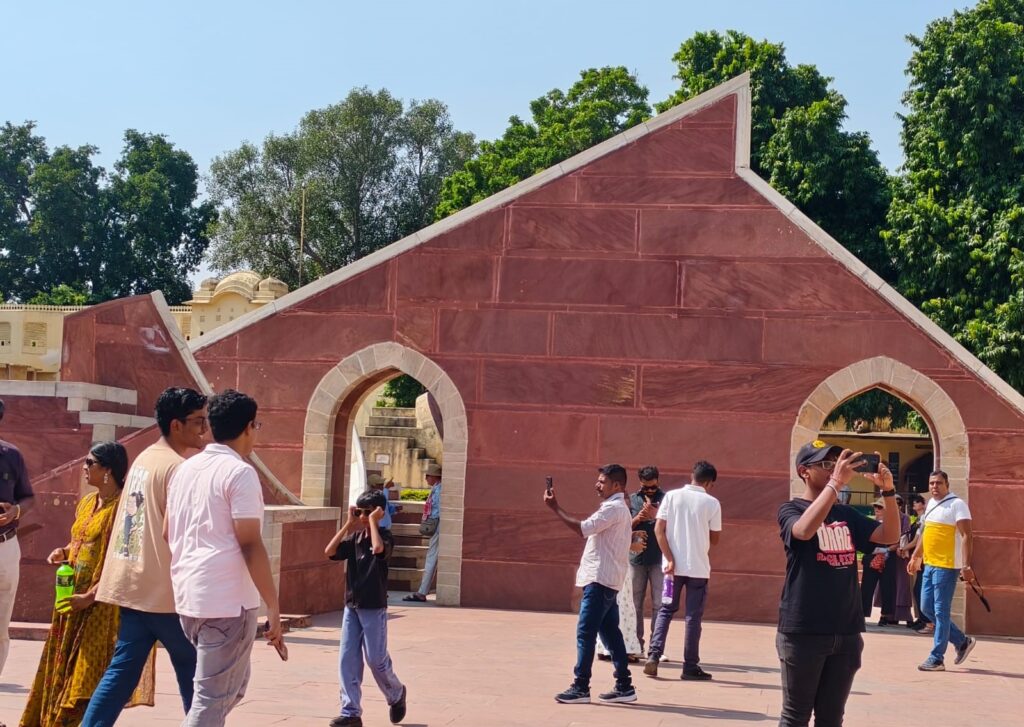
At the same time, without briefly explaining the purpose or working of at least a few instruments, such a write-up may feel incomplete. This attempt is therefore a simplified effort to provide a basic understanding of some of the devices encountered, while also serving as a small tribute to the brilliant minds behind these remarkable creations. The positions of the Sun and stars likely held great importance in their era, influencing decisions related to war and other critical matters.
Sun Dials – Where Jaipur’s Latitude Meets the Hypotenuse
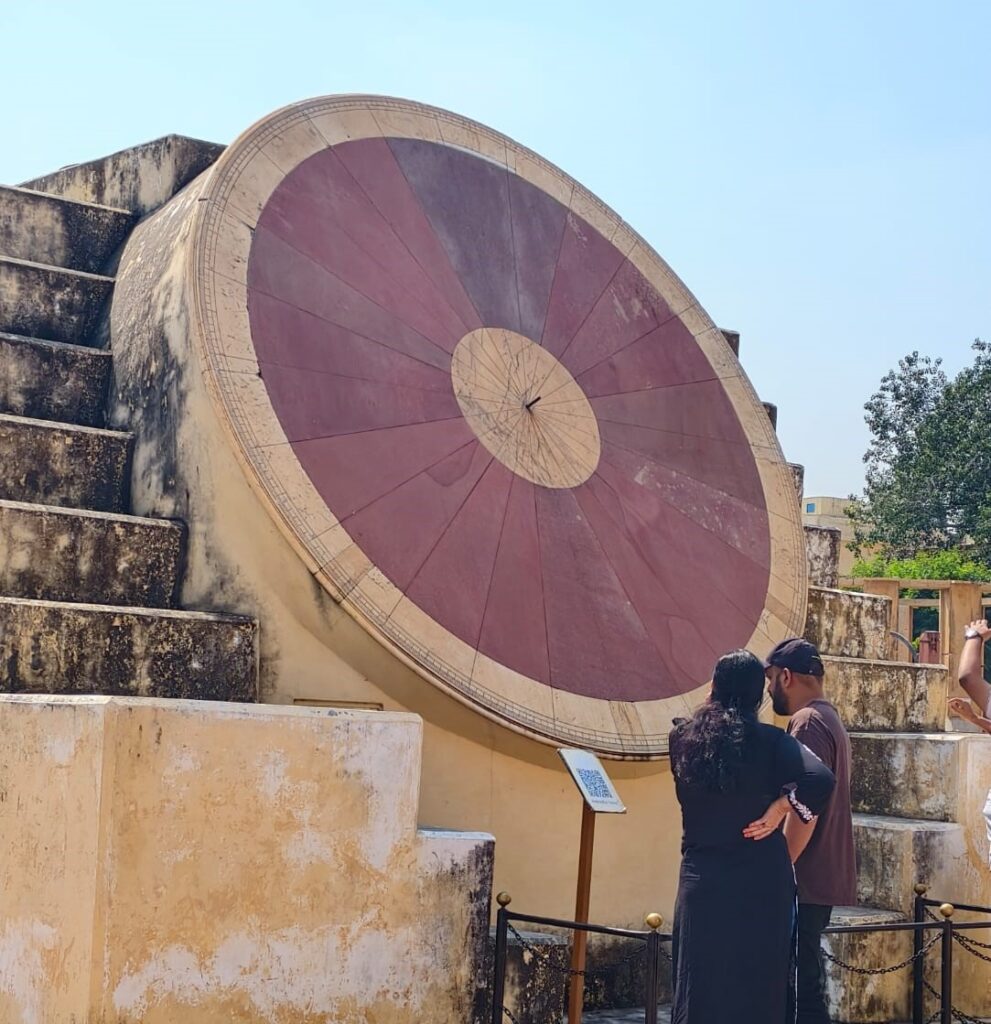
The small sundial is the first structure near the entrance. It is triangular in shape, constructed from red sandstone and marble. Its longest side, the hypotenuse, is inclined at an angle of 27 degrees—matching the latitude of Jaipur. The markings and divisions are so precise that the shadow cast by the sundial indicates the exact local time. As demonstrated by the guide, it aligned perfectly with the time shown on our watches.
The next instrument relates to the Pole Star, which is visible to the naked eye and has long been used to identify the direction of north. It is one of the simplest instruments at Jantar Mantar.
Following this is the equatorial instrument, consisting of a massive pair of circular plates facing north and south. These are slightly inclined so that they remain parallel to the Earth’s equator. A rod, known as a gnomon, projects from the structure and is aligned parallel to the Earth’s axis of rotation. The plates are marked with precise scales, allowing the time to be determined accurately through the shadow cast by the gnomon.
Stone Dials – Bringing the Sky into Marble and Stone
The Yantra Raj appears as a large circular disc, over two meters in diameter, made of red stone with a central opening, suspended between two curved supports. It is regarded as the “King of Instruments” here because of its wide range of applications. Such is its importance that the Maharaja is said to have authored two volumes explaining its working in detail.
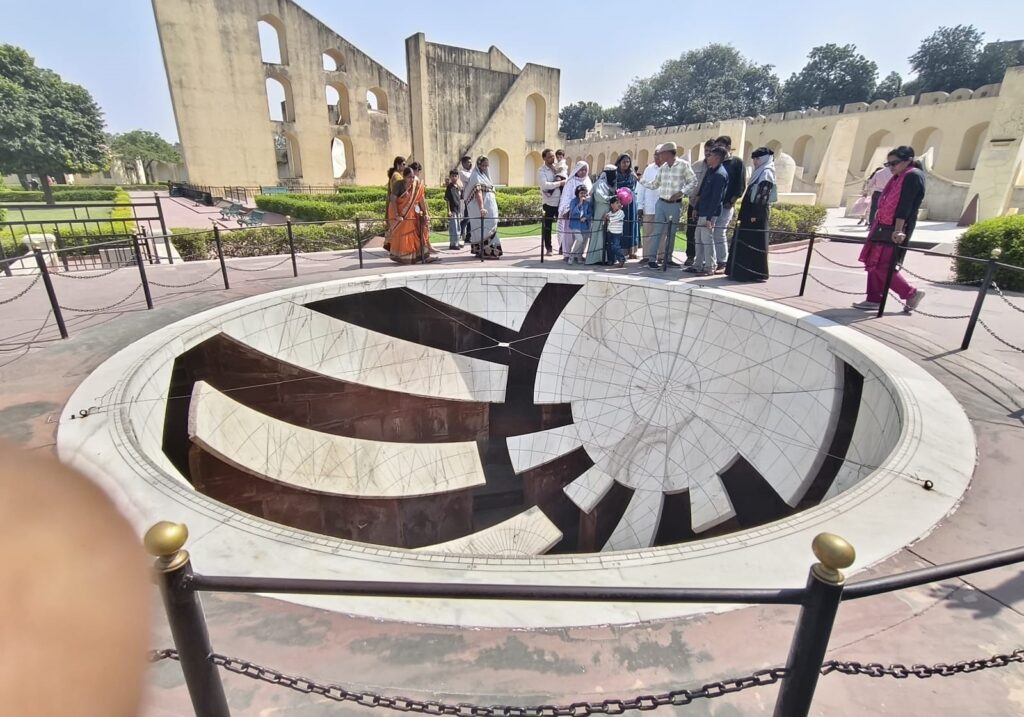
Another major attraction is the large sundial, remarkable for both its scale and its towering structure, somewhat reminiscent of the Qutub Minar. While its purpose is similar to that of the smaller sundial, its immense size allows for far greater precision in measurement. It stands as a testament to the dedication and continuous innovation of those who designed and built these instruments in pursuit of higher accuracy.
There is also another massive circular instrument, more than five meters in diameter, with an opening at its centre. It is strategically positioned to help determine the locations of stars and planets, further showcasing the advanced astronomical understanding of that time.
Jantar Mantar – Where Astronomy Connects with Human Belief
Next, we came across a set of instruments that felt more familiar, especially to those who relate astronomy to the human life cycle through belief systems. These were spread across different locations and built in varying shapes, representing the twelve zodiac signs such as Leo and Capricorn. Although the method of using them was quite complex, it added a sense of enjoyment as we tried to identify our respective zodiac signs based on our birth details.
As we walked among these instruments under the intense sun, with hardly any shade for relief, it was impossible not to admire the knowledge, vision, and determination of the rulers who conceived them. Their ability to channel such advanced understanding into the planning and construction of these remarkable structures is truly impressive. One can only imagine that, at the time, such achievements must have earned global admiration—and perhaps even stirred a sense of envy among their contemporaries.
Solutions, Tracking, Measurement and Calibration in Astronomy at Jantar Mantar
Among the instruments, we also encountered some comparatively smaller ones, which were not only used for measurements but also employed to solve specific astronomical problems.
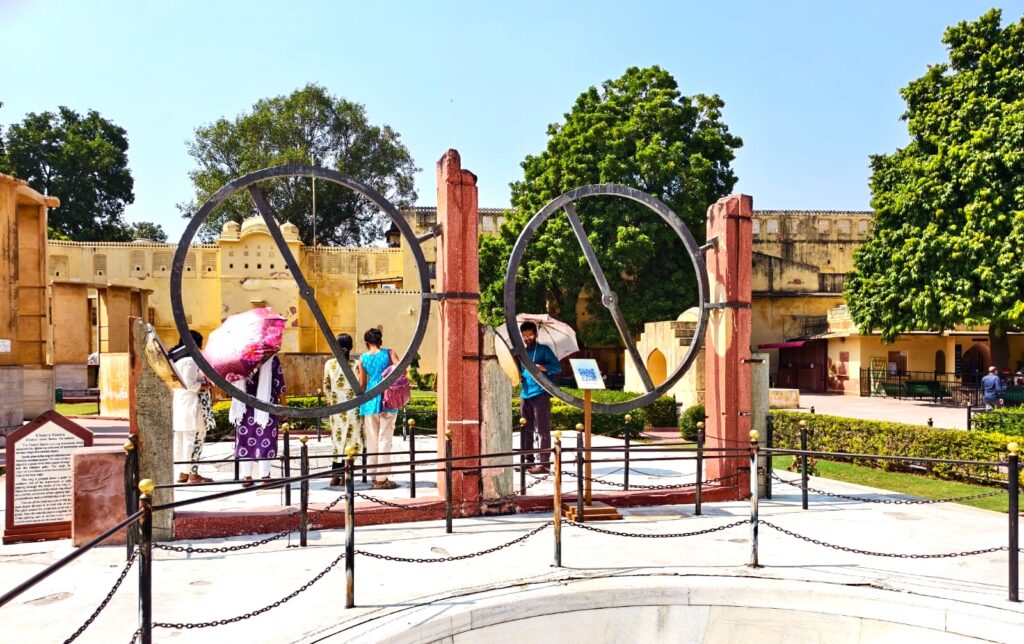
Nearby stood the Chakra Yantra, featuring 360-degree markings. It allows observers to track particular heavenly bodies through a tube while simultaneously measuring their position and the time at which they pass through.
Another notable instrument is the Jaiprakash Yantra, named after Maharaja Jai Singh, who designed it. This instrument functions more as a calibration tool, used to verify the readings and markings of the other devices.
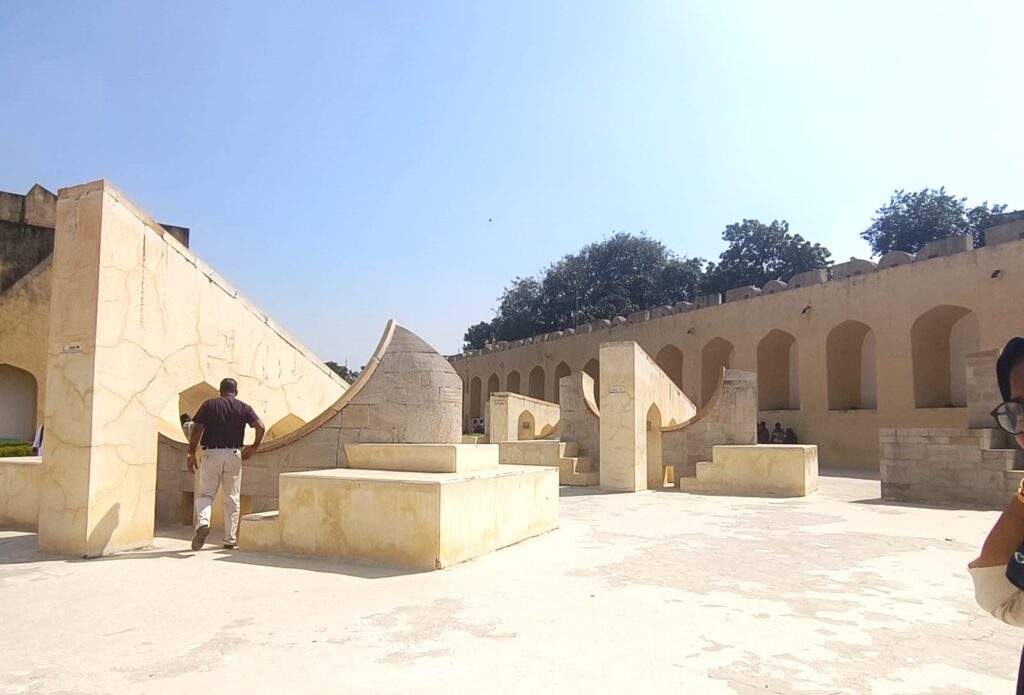
We also saw two sets of twelve vertical cylindrical columns, each with slight projections at specific intervals and a rod positioned at the centre. These columns are marked with 360 vertical and 90 horizontal divisions, representing azimuth and altitude. This setup enables precise measurements of celestial objects, both during the day and at night.
Jantar Mantar – Scientific Brilliance That Leaves You Amused and Satisfied
A few more instruments could be seen, each having served the kingdom centuries ago, yet still retaining their precision and functionality. As we concluded the visit, a sense of awe and admiration lingered—there was a deep satisfaction, mixed with amusement, that few other tourist sites could inspire. The Jantar Mantar in Jaipur not only offers a glimpse into the scientific brilliance of the past but also leaves visitors reflecting on the vision, intelligence, and creativity that brought such monumental ideas to life.
Expert insight:
According to the Archaeological Survey of India, the instruments at Jantar Mantar Jaipur were designed with remarkable precision to observe celestial movements and measure time with impressive accuracy.
Virendra Nath Sharma
- Expert on Indian astronomical instruments
- Has written extensively on Jantar Mantar observatories
- Published book – Sawai Jai Singh and his Observatories
Loved Janta Mantar – Read another story on Jaipur – Click here for Jaipur – Abundance of Royalty, Part 1 | Exploring the Pink City’s Timeless Charm




After reading your blog… it felt as if I had been there! Beautifully articulated