
A PREFACE
A garden visit is hardly a subject for a blog, but a visit to the Mughal Gardens, also known as Rashtrapati Bhavan Gardens, changed that perception. A few lines from the official page itself are enough to prove the worth of this visit. As per the official page by the Government – AMRIT UDYAN
Spread over a vast expanse of 15 acres, Amrit Udyan has often been portrayed, and deservedly so, as the soul of the Rashtrapati Bhavan. Originally, it included East Lawn, Central Lawn, Long Garden and Circular Garden. During the term of former Presidents Dr. A.P.J. Abdul Kalam and Shri Ram Nath Kovind, more gardens were developed, namely, Herbal-I, Herbal-II, Tactile Garden, Bonsai Garden and Arogya Vanam
A SHORT NOTE ON DELHI’S VVIP AREA
VVIP areas in Delhi always remain an enigma to outsiders — maybe even for some pure Delhiites born and brought up here. For a few local colleagues, these locations still feel like unknown territory, particularly when it comes to navigating entry and exit points on these roads, despite having traveled through them many times.

While in Delhi, getting a chance to travel through the VIP Street and catch a glimpse of VVIP locations such as the Parliament Building, Rashtrapati Bhavan, and other important buildings related to it always brings a special feeling for any non-Delhiite. This area always looks so calm and peaceful within the bustling, crowded Delhi encircling it — a city for the privileged within the city of the common man, both mixed.
Since it is the country’s capital city, Delhi is one of the most privileged ones, such that at the right time, people get a chance to experience or witness many things that other metropolitan cities do not get.

When a piece of news caught my eye that visitors could enter the Rashtrapati Bhavan Garden for a short duration, without thinking twice, I decided to choose a convenient holiday for visiting the same and made calls to a few friends asking them to join.
MAYBE THE CLIMATE TOO PLAYS ITS PART
February and March in Delhi or the entire northern region are good times for outings. For those who like cool climates, this may be ideal for roaming. One can be outside without using many layers of clothing compared with the previous few weeks or months. The statement is to paint a picture of how cold Delhi would be in its peak winter.
And on a foggy weekend morning, I was waiting in a relatively long queue leading to the entry gate of Mughal Gardens while many of my colleagues were likely to be under their blankets. That made for one of the perfect Sundays spent in the capital after a long time. A sense of pride was evident on most faces of those who were good enough to beat the climatic inconvenience. They were all set to enter the most important and secure piece of land in the capital of India.

Many locals, along with tourists from many states, were present in the long queue, eager to get a feel of the surroundings exclusively made and maintained for the first person of the Nation. Rather than feeling like a picnic mood, my mind was framing up as a special guest invited to experience the most privileged area of India’s national capital.
NO PHOTOGRAPHS PLEASE WITH CAMERA
In a place like the President’s estate, the security checks must be as strict as anyone can imagine. And it was rightly so, which looked okay for all. Many personal items were not allowed to be carried in. For those, arrangements were made very professionally to deposit them safely at the entrance to be collected after the visit. As expected, cameras too were on the list of banned items. It caused slight disappointment to everyone. But luckily, beyond any pondering of logic, mobile phones were missing from the list of banned items.

HISTORY OF MUGHAL/ RASHTRAPATI GARDENS
Some history is hard to erase, replicate, or replace. The Mughal dynasty ruled over different parts of India for many centuries. But some contributions made by them are still not expired — instead, known by that name even at present. Mughal Gardens are one such lovely location existing in many places like Delhi, Agra, and Srinagar. Thousands of people still find time to visit those gardens because of their attraction, enviable designs, and different kinds of flowers and fountains arranged beautifully.
The Mughal/ Rashtrapati Gardens also come in the same category. The British rulers were then so fond of their system that and tried to include its style in Western culture. And this particular garden offers a mixture of both. During the British era, the main contribution to developing Delhi with magnificent buildings and other infrastructure was by Sir Lutyens. He was the main architect behind these, and many VVIP locations in Delhi are still known by his name as the Lutyens’ area. In the capital of India, these are some of the most sensitive and most sought-after areas among power circles.

The credit for the design of RB Gardens also goes to him. He tried to incorporate many aspects left by the Mughals. The fact remains that neither is it in memory what exactly the Mughal style of gardening was, nor can one recollect the English way of flowering or plants. The only word familiar in Delhi’s life was Lutyens, of course. These historical messages were immaterial by the time we entered the garden.
THE FIREWORKS WITH FLOWERS
There, we were exposed to a rare sight that looked like fireworks — fireworks containing all the colors in the world that had landed safely on a green blanket. Eyes were recognizing only colors with different shapes and sizes first, leaving the rest of the atmosphere to take a backseat. Soon after, we were mesmerized by the sight of a Rangoli — a beautiful, big rectangular arrangement laid with different flowers in different colors. This was very close to the main entrance. It was like an Indian way of welcoming others, seen in many homes across many places, especially in the South.

The initial excitement was daunted by a painful reality, as we saw a board instructing everyone that “photography is strictly banned.” Everyone thought mobile cameras would be useful in capturing these rare plants and flowers.
Remember, we were in a place where the person considered to be the first among 1.30 billion Indians resides — a place where every type of security arrangement that technology has developed so far might be in place. And any attempt to violate this rule could most likely land one in prison. So even the distant thought of an adventurous click in whichever trick was out of scope.
SHAPES, CANALS, AND FOUNTAINS
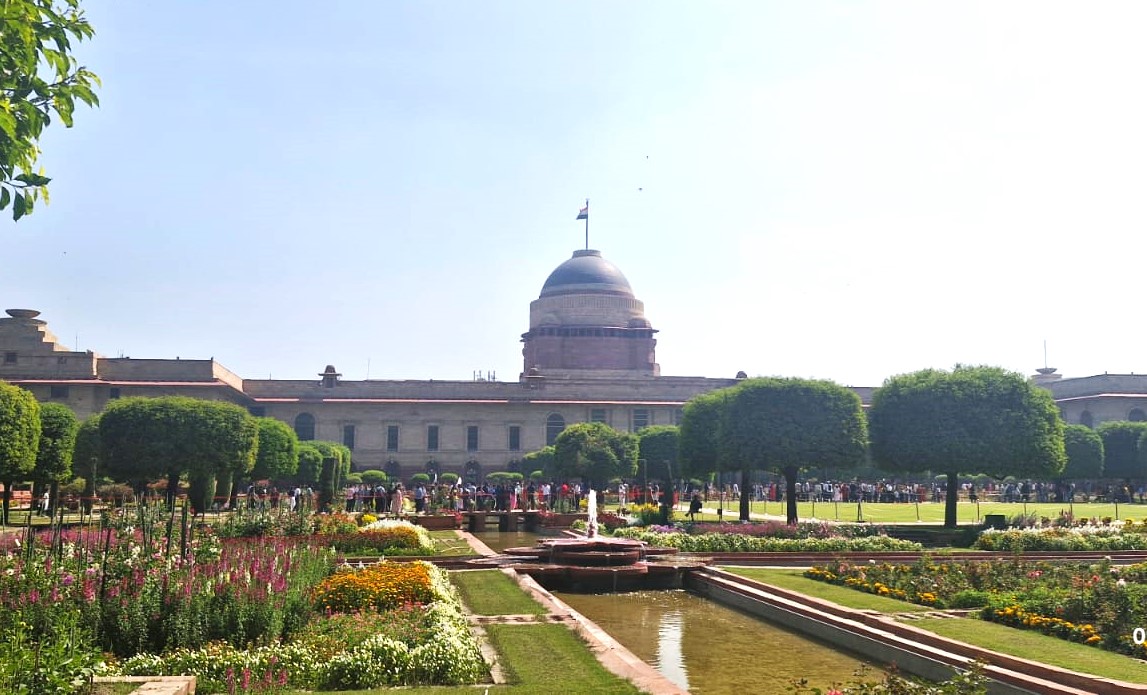
There were many separations and identifications for each part of the area — rectangular garden, circular garden, and long garden, etc. It was a feast for the eyes to watch each different type of flower and plant in the cool climate, covered with slight mist over the whole area.

The entire huge area was arranged with colorful plants and designs along with water canals and walkways in between. The President’s building at the far end, covered in the slight fog of winter, stood tall — quite interesting to think that we were inside the complex of the first person of India. Surveillance from security was much less visible than we expected. Only a few policemen were seen here and there, which came as a surprise.
As time went by, the crowd was getting thicker, and instructions were heard to move on slowly. The temptation was high to use the mobile to attempt a few snaps. But even if it looked harmless, the thought of abiding by the rules inside the President’s premises was high on the priority list. Looking at others, it also came as a surprise that some seemed not much interested in the tag of being a good citizen inside such a sensitive zone. They were found using their smartphones to capture the rare species of plants and flowers.
THE VARIETIES OF FLOWERS AND PLANTS
Around 150 types of roses might have been brought from different parts of the world, as per the information given to us. Many varieties of bougainvillea, daffodils, etc., were planted and maintained with utmost care.
One more important variety was Tulips, which may not be familiar across India. It was truly attractive. To get a brief know-how of its importance, one season in April is fully dedicated to Tulip flowers in Srinagar, India, where tourists from across the country and outside come to see them.
THE NAMES OF FLOWERS HAVE UNIVERSAL APPEAL
While admiring these rare landscapes and the fountains placed between them, I saw other people trying to capture every piece of attraction passing by with their smartphones. Soon, I, too, changed my resolve about being a law-abiding citizen for a while. With due respect to the constitution and the prevailing laws, I finally took my phone out and started taking a few photographs from whatever available spots to capture the rare flowers around.

Attached photographs speak more words than I could write. The only interesting part they might miss is how the flowers are named — some curious, and sometimes funny. Some roses have the names Taj Mahal, Eiffel Tower, Belami, Black Lady, Paradise, Blue Moon, and Lady X. Others bear names like Mother Teresa, Raja Ram Mohan Roy, Mr. Lincoln, John F. Kennedy, Jawaharlal, Queen Elizabeth, and Christian Dior. Arjun and Bhima from the epic Mahabharata were also on the list.
But the most striking name was LOVE, given to a violet-colored flower. For me, it was like a symbolic gesture of appreciation for the authorities or the respected Presidents who agreed to open their private complex to the common man, or aam aadmi, reflecting the true meaning of democracy.
- Link for Wikipedia Page on general Rashtrapati Bhavan Gardens – Rashtrapati Bhavan Gardens
Discover more from NOTES FROM THE ROAD
Subscribe to get the latest posts sent to your email.
Beautiful ☺
The colors of the flowers are amazing!
I love gardens and this seems like such a wonderful place to visit. It’s a shame you can’t bring cameras, but then I have to admit that I find myself agreeing with the policy. Sometimes cameras will just take away the beauty of being in the moment. Would love to visit here someday!